
01 / The old port
An inn in a Cinque Port
Hythe was one of the original five Cinque Ports. The towns supplied ships and crews to the Crown in return for privileges, giving this stretch of coast an important trading and defensive role.
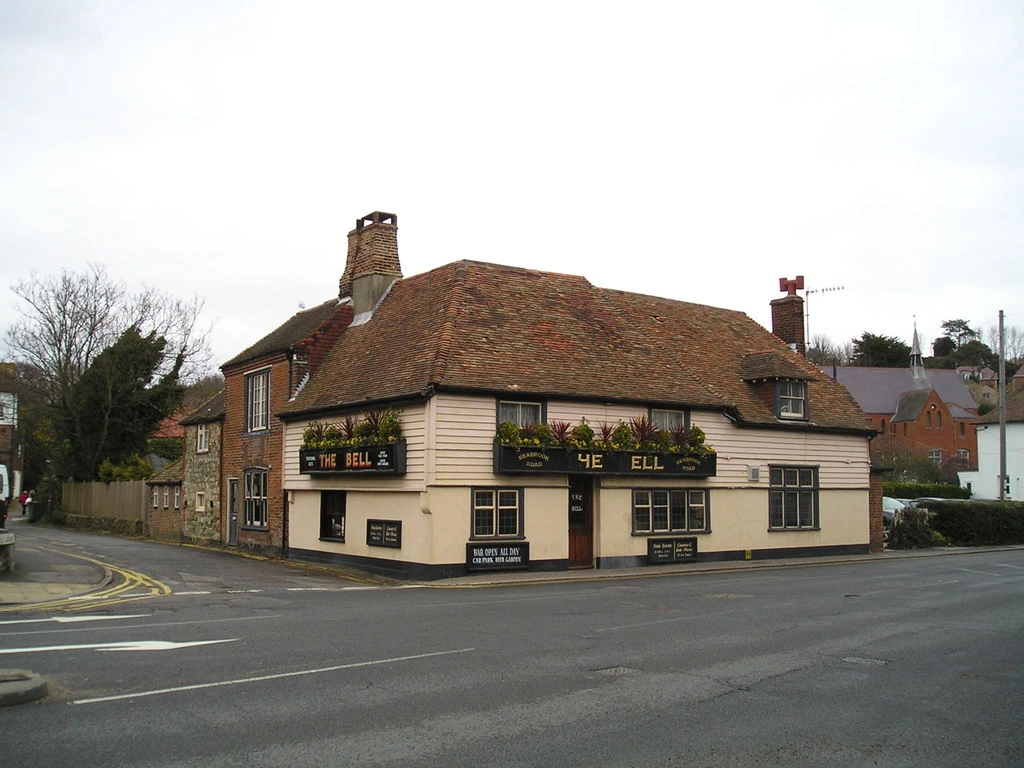
Kent CAMRA describes The Bell as a principal inn during Hythe’s port days. Its account suggests that parts of the building may date to the 15th century and that deeds go back more than 400 years. Several Hythe pubs have been described as the town’s oldest, and a precise founding date for The Bell remains uncertain.
02 / The building
Look up at the roofline
Historic England records a two-storey, L-shaped, timber-framed building. The steep tiled roof has a 17th-century chimney stack, and the frontage was remodelled in the 18th century. The south-facing upper storey is weatherboarded and the west side is tile-hung. The rear includes both red brick and rubble stone.
On the west front, traces of a beam and brackets show where the upper floor once projected over the ground floor. The inn was first listed at Grade II on 21 December 1973.
Historic England list entry 1116490Kent Historic Environment Record
03 / Local lore
The millstream and the smugglers
CAMRA records a millstream that once ran through the cellar. Local stories tell of a passage used to hide smuggled spirits, casks floated in on the water, and a lookout posted by the chimney. Local historian Anne Petrie also records a tale about an attic hoist and another about a Grey Lady in the cellar. These are stories passed down about the inn.
What was found in the fireplace?
One often-repeated tale says that two customs officers’ skeletons were uncovered when the old fireplace was opened in 1963. In Petrie’s account, the builder found mugs, pipes, keys and pig bones. The story of the officers survives in pub lore.
04 / Coastal defences
Fort Twiss and the canal
The track opposite The Bell later became Twiss Road. It led towards Fort Twiss, built on the seafront in 1798. Petrie records that soldiers and coastguards from the fort frequented the inn. Nearby, work on the Royal Military Canal began in 1804 as a defence against a threatened French invasion. The roughly 28-mile waterway was completed in 1809 and opened for public use in 1810.
One evening at The Bell made its way into the records. In November 1826, John Pendall, a seaman of the Coastal Blockade, was robbed of his silver watch on his way back to Fort Twiss after drinking at the inn. Thomas Hyham was convicted in 1827. After his mother petitioned for clemency, his death sentence was commuted to transportation for life.
Historic England on the Royal Military CanalAnne Petrie’s account of the Hyham case
05 / The people
Names in the old directories
Trade directories put names to the inn’s nineteenth-century history. Pigot’s lists Henry Marshall in 1828 and Henry Jeffery in 1832 and 1839. Later entries record Charles Rice Nelson in 1874 and 1882, and Annie Denne in 1891.
The Post Office Directory names Mary Ann Brown in 1913. The Ridley surname then appears in entries from 1922 to 1938. These are snapshots of the people associated with the inn at different dates.
06 / A changing address
From Newington to Hythe
Bell Inn Road, the short link between Mill Road and Seabrook Road, takes its name from the pub. An 1877 Ordnance Survey map shows the parish boundary running down the road. The Bell stood on the Newington side, and inquests into sudden deaths in that parish were held at the inn.
In 1914, Hythe Town Council agreed that Seabrook Road should begin at The Bell. The civil parish boundary moved as far as the Sea View Hotel. The church parish boundaries did not change at the same time. The inn stands on Seabrook Road, Hythe.